Why pipes burst
Most bursts have one of four causes, and the cause decides how much of the pipe the plumber replaces.
- Freezing. Ice forms in a cold section and blocks the pipe. Water trapped between the ice and a closed faucet has nowhere to go, pressure climbs, and the pipe splits, often a short distance from the ice itself.
- Corrosion. Pinholes and thinning walls in old copper or galvanized pipe give way under normal pressure. Our page on pinhole leaks in copper pipe covers the early stage.
- High pressure. Supply pressure above 80 psi or sharp water hammer stresses joints and fittings.
- Damage and failed fittings. A nail through a wall, a crushed line, or a fitting on older plastic pipe that lets go.
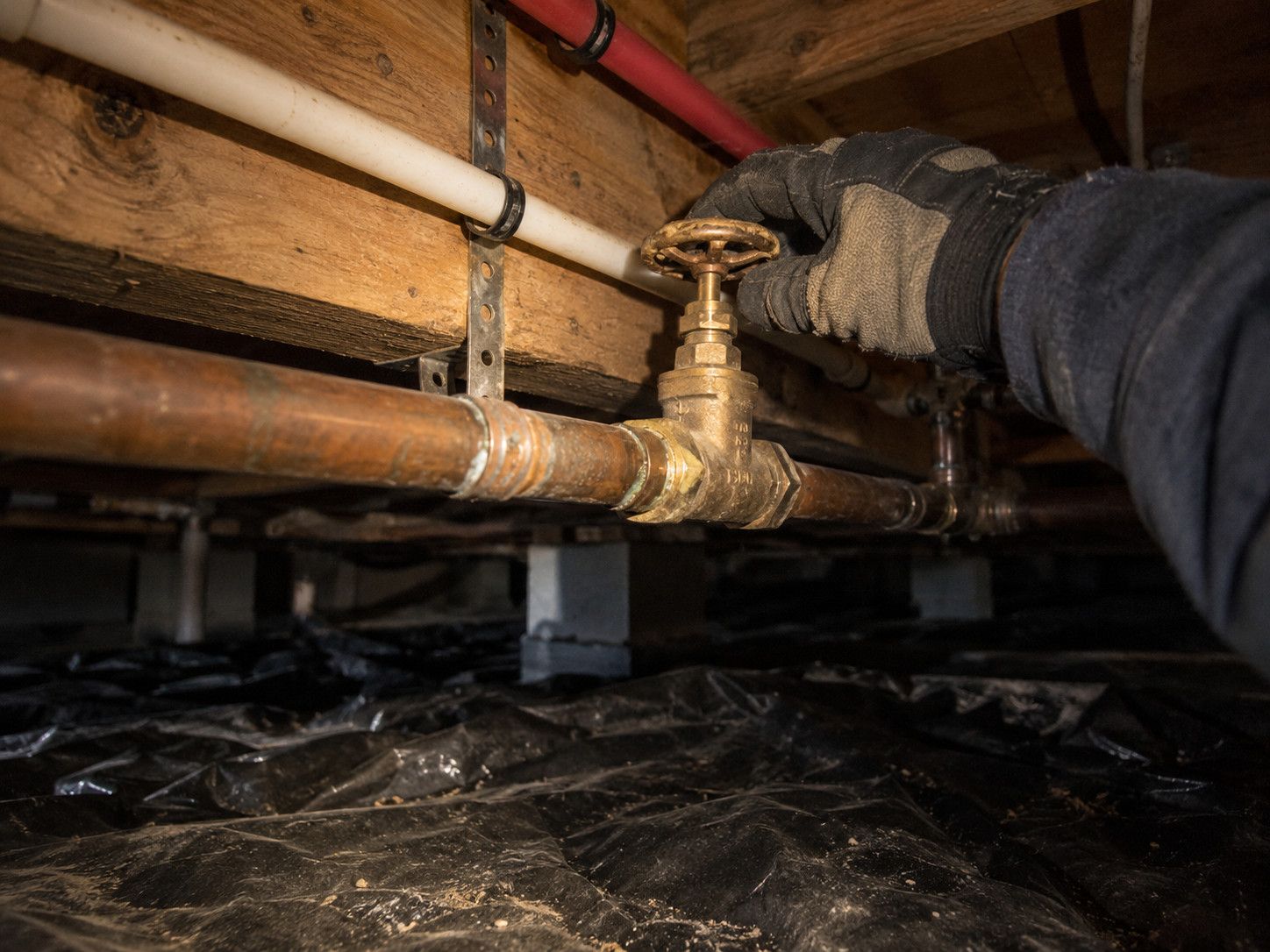
Frozen pipe: thawing without making it worse
- Open the faucet the frozen pipe feeds, so melting water and pressure have an outlet.
- Warm the pipe from the faucet end back toward the frozen spot, with a hair dryer, a space heater at a safe distance or warm towels.
- Never use an open flame. It can start a fire inside the wall, and heating copper too fast can burst it.
- If the pipe is inside a wall, a ceiling or a crawl space you can't reach, or if you see a split, close the main and call.
Fixr's burst pipe guide mentions a flat rate of around $100 for a plumber to thaw frozen pipes.
How the repair is made
With the water off, the plumber opens access to the pipe if needed, cuts out the damaged section and some of the pipe on either side, and joins new pipe with soldered couplings, press fittings, push-fit fittings or PEX connections. After a freeze, they check the rest of the exposed run for other splits, because one cold night often damages more than one spot. The system is then refilled, bled of air and checked under pressure before the wall is closed. New pipe and fittings for drinking water must meet EPA's lead limits.
What the repair costs
| Item | National figure |
|---|---|
| Typical repair (average $500) | $200–$1,000 |
| Minor repair, no pipe replaced | from $150 |
| New piping in a hard-to-reach spot | up to $2,000 |
| Replacing burst pipe, per linear foot | $150–$250 |
| Thawing frozen pipes, flat rate | about $100 |
| Emergency call-out fee, if after hours | $200–$300 |
Sources: Fixr’s burst pipe guide (updated August 19, 2022, the most recent edition) and Cost to Hire a Plumber (January 30, 2025) for the call-out fee.
Plumbers who answer 24/7 exist in most areas, and same-day repair is common once the water is off, but nights and holidays carry the emergency fees above. If the main is closed and the house is warm, a morning appointment often costs less.
Pipe burst in a wall or ceiling
A burst behind drywall shows as a spreading stain, bulging paint, water running from a light fixture, or the sound of spraying water. Close the main immediately. The plumber opens the smallest opening that gives access to the pipe; patching and finishing the drywall is usually separate work. Drying out the building afterward is a different trade from plumbing, and we don't cover it here.
Preventing the next one
- Insulate pipes in exterior walls, crawl spaces, attics and garages, and seal the drafts that reach them.
- Disconnect garden hoses before the first freeze; a hose left on can split a freeze-resistant faucet inside the wall.
- Keep the heat on when you travel in winter, or close the main and drain the lines.
- Have supply pressure checked if it exceeds 80 psi; see water pressure for the gauge test.
For everything else that counts as urgent, start at our emergency plumber page.
Burst and frozen pipe questions
Will homeowners insurance cover a burst pipe?
Policies commonly cover sudden and accidental pipe bursts, and commonly exclude freezing in a house left unheated or damage from a slow leak. The pipe repair itself is often treated differently from the damage it caused. Read the policy and call the insurer early.
Can I wrap the pipe until the plumber comes?
A pipe repair clamp or rubber sleeve with a hose clamp can slow a small split once the pressure is off. It is a temporary patch. With the main open, a burst pipe will beat most tapes.
Why did the pipe start leaking only after it thawed?
It split while frozen, when the ice held the water back. The leak appears as the ice melts and water flows again, which is why the main should be closed before thawing a frozen section.
Do PEX pipes burst?
Less readily than copper, because PEX stretches as water freezes. Its fittings can still fail, and a PEX line that freezes repeatedly can split.
Sources
- Burst Pipe Repair Cost, Fixr, updated August 19, 2022.
- Cost to Hire a Plumber, Fixr, updated January 30, 2025.
- Lead content limits for pipes, fittings, fixtures, solder and flux (Safe Drinking Water Act §1417), U.S. Environmental Protection Agency, updated May 19, 2026.
Reviewed September 27, 2026. Found an error? Write to admin@plumbingrepairquotes.com.