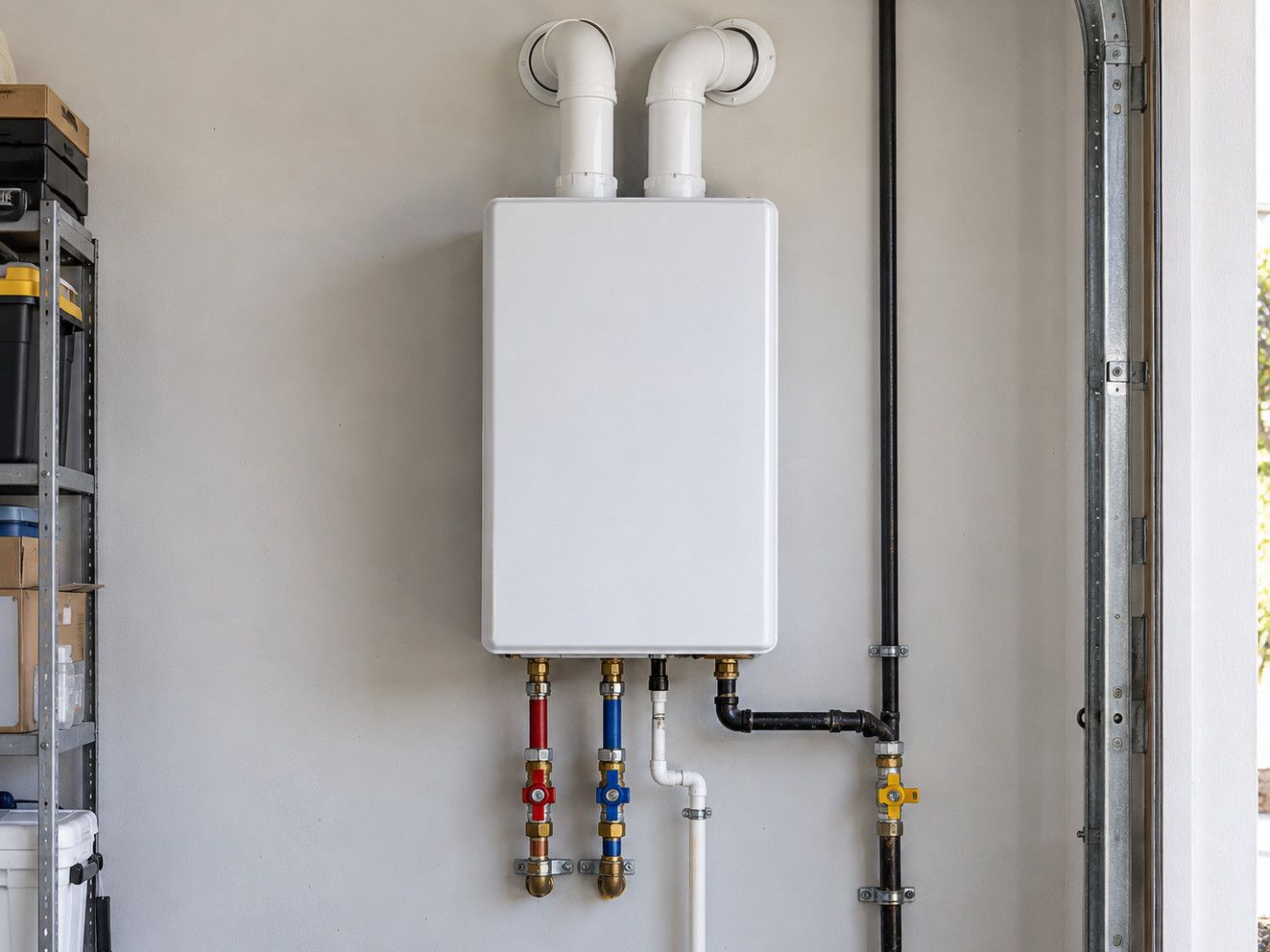
What the switch costs, and why
The unit is only part of the bill. The same Fixr guide notes that tankless heaters typically cost nearly twice as much as tank models, and the conversion work sits on top of that. The table shows where the money goes on a gas conversion.
| Line item | What it involves | National figure |
|---|---|---|
| Installed unit | Heater, mounting, water connections, service valves | $1,000–$4,000 |
| Tank-to-tankless conversion | Roughing in gas, venting and electrical for the new unit | +$400–$1,800 |
| Permit and inspection | Plumbing and often a separate gas or mechanical permit | set locally |
Source: Fixr, Water Heater Installation Cost, updated January 27, 2026.
Why the gas line usually changes
A tank heater burns gas slowly and keeps a reserve of hot water. A tankless unit has no reserve, so it has to heat water as fast as it flows, and it burns much more gas per hour while running. Gas piping is sized under the fuel gas code from the appliance's input rating, the length of the run and the supply pressure. A line that fed a tank heater for twenty years is often too small, and sometimes the meter is too. A plumber should add up every gas appliance in the house before quoting, not just the heater.
Venting and condensate
Most gas tankless units vent through the wall or roof with their own sealed pipe, not through the old chimney. Condensing models, which squeeze extra heat out of the exhaust, produce acidic condensate that needs a drain, and many jurisdictions require a neutralizer ahead of it. Non-condensing models run hotter exhaust and need the vent material their manufacturer specifies. Either way, the old vent connector comes out and the chimney opening may need a cap.
Electric tankless: check the panel first
Electric tankless heaters avoid gas and venting entirely but draw large currents while running. A whole-house electric model can need more amperage than an older panel has to spare, and the quote may include a panel or service upgrade that costs more than the heater. Point-of-use electric units under a single sink are a different, much smaller job.
Size it by gallons per minute, not by gallons
A tank is sized by how much hot water it can deliver in an hour. A tankless unit is sized by flow: how many gallons per minute it can heat through the temperature rise your incoming water needs. The Department of Energy's building science guidance says high-efficiency whole-house units can often provide 2 to 5 gallons per minute. Add up the fixtures you expect to run at the same time.
| Fixture | Standard flow | WaterSense flow |
|---|---|---|
| Showerhead | 2.5 gpm | 2.0 gpm |
| Bathroom sink faucet | 2.2 gpm | 1.5 gpm |
Source: EPA WaterSense, Showerheads (updated March 3, 2026) and Bathroom Sink Faucets (updated June 16, 2026).
Two standard showers and a bathroom faucet add up to 7.2 gallons per minute, past the range a single unit usually covers. With WaterSense fixtures the same three add up to 5.5. The second number that matters is the temperature rise: water entering at 45°F in a northern winter needs a 75-degree rise to reach 120°F, and every unit delivers fewer gallons per minute at a larger rise. Manufacturers publish flow-at-rise tables, and the plumber should size from the winter figure.
Federal rules for gas tankless units
The Department of Energy published stricter efficiency standards for gas-fired instantaneous water heaters in December 2024, then withdrew that rule as of May 20, 2025, after two delays. Current standards stay in place for these units. The separate standards for tank heaters, with compliance required from May 6, 2029, are unchanged.
Tankless water heater repair and upkeep
Scale is the usual enemy. Hard water leaves minerals in the heat exchanger, the unit starts reporting overheat or flow errors, and descaling with a small pump and a descaling solution clears it. Beyond scale, the replaceable parts are the flame sensor, the igniter, the flow sensor and the fan. Most units display an error code that points to the part, which shortens the diagnosis. The broader water heater repair guide compares these faults with tank heater failures, and sizing a water heater explains the first-hour method for tanks, if you are weighing both.
Tank or tankless: a short comparison
| Tank | Tankless | |
|---|---|---|
| Sized by | First-hour rating | Gallons per minute at your temperature rise |
| Installed range (Fixr, 2026) | $900–$3,000 | $1,000–$4,000, plus conversion |
| Standby heat loss | Yes, through the tank walls | None while idle |
| Works without power | Standing-pilot gas models | No |
| Main maintenance | Flushing sediment, anode checks | Descaling the heat exchanger |
If the numbers favor staying with a tank, tank replacement costs are usually lower and the job takes half a day.
Tankless questions before you commit
Can a tankless heater run out of hot water?
It won’t run out the way a tank does, but it can run short. When the fixtures open at once ask for more gallons per minute than the unit can heat to temperature, the water coming out gets cooler. Sizing by flow rate is what prevents that.
Does a tankless heater work in a power outage?
Gas models still need electricity for the controls, the igniter and the combustion fan, so most stop when the power goes out. Electric models stop too. A tank heater with a standing pilot is the only common type that keeps working.
Do I need a water softener with a tankless heater?
Not always, but hard water shortens the time between descaling. The U.S. Geological Survey classes water above 120 milligrams per liter as hard and above 180 as very hard; in those areas, plan on regular descaling or treatment ahead of the heater.
Is tankless worth it in a small house?
It can be, if the household rarely runs two showers at once and the gas line and venting are easy to adapt. Where the conversion work is extensive, a new tank heater often pays back sooner.
Sources
- Water Heater Installation Cost, Fixr, updated January 27, 2026.
- Water Heaters, Gas-Fired Tankless (Building Science Education), U.S. Department of Energy.
- Consumer Water Heaters: energy conservation standards and compliance dates, U.S. Department of Energy.
- WaterSense: Showerheads, U.S. Environmental Protection Agency, updated March 3, 2026.
- WaterSense: Bathroom Sink Faucets, U.S. Environmental Protection Agency, updated June 16, 2026.
- Hardness of Water, U.S. Geological Survey Water Science School.
Reviewed September 27, 2026. Found an error? Write to admin@plumbingrepairquotes.com.